A Glossary of Web Hosting Terms
Web hosting comes with its own vocabulary. If you have ever wondered what the difference between a nameserver and a DNS record is, or why someone is talking about "bandwidth" and "inodes" in the same sentence, this glossary is for you. Terms are grouped by topic for easy browsing.
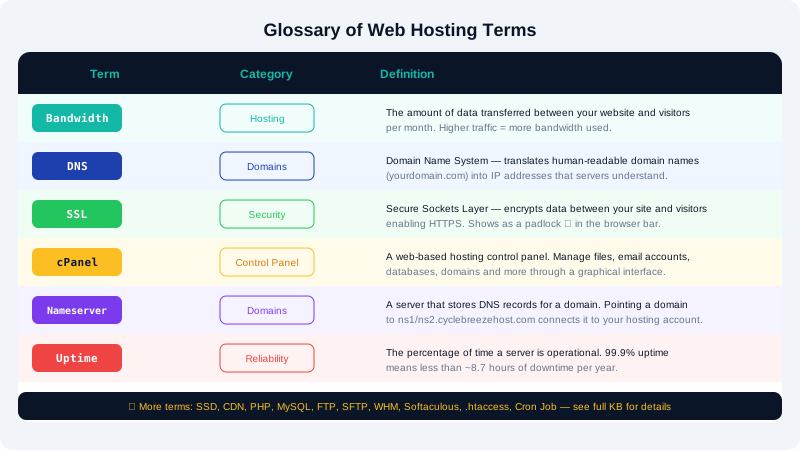
Hosting Fundamentals
Shared Hosting A hosting environment where many websites share the resources (CPU, RAM, storage) of a single server. Cost-effective for most personal and small business sites.
VPS (Virtual Private Server) A virtualized server with dedicated allocations of CPU and RAM, isolated from other users on the same physical machine. More powerful and configurable than shared hosting.
Dedicated Server An entire physical server reserved exclusively for your use. Provides maximum performance and control, suitable for high-traffic or resource-intensive applications.
cPanel A web-based control panel used to manage hosting accounts. From cPanel you can create email accounts, manage files, install software, and configure databases.
LiteSpeed A high-performance web server software. CyclebreezeHost servers run LiteSpeed, which handles traffic significantly faster than traditional Apache, especially for WordPress sites.
Bandwidth The total amount of data transferred between your website and its visitors in a given month. Measured in gigabytes (GB) or terabytes (TB).
Disk Space (Storage) The amount of space on the server allocated to store your website files, databases, and email.
Inodes Each file, folder, and email on your account counts as one inode. Shared hosting plans have inode limits to prevent any single account from storing millions of small files.
Uptime The percentage of time your website is online and accessible. CyclebreezeHost guarantees 99.9% uptime on all hosting plans.
Domain Names
Domain Name
The human-readable address of a website, such as yourbusiness.com. Domains are registered through a registrar like CyclebreezeHost.
TLD (Top-Level Domain)
The suffix of a domain name. Common examples: .com, .net, .org, .ng, .africa.
DNS (Domain Name System) The system that translates domain names into IP addresses so browsers can locate servers. Think of it as the internet's phone book.
DNS Record An entry in a domain's DNS zone that provides specific instructions. Common record types:
| Record | Purpose |
|---|---|
| A | Maps a domain to an IPv4 address |
| AAAA | Maps a domain to an IPv6 address |
| CNAME | Creates an alias pointing to another domain |
| MX | Specifies mail servers for the domain |
| TXT | Stores text data; used for SPF, DKIM, and domain verification |
Nameserver A server that holds the authoritative DNS records for a domain. Changing nameservers at your registrar delegates control of your DNS to a new provider.
Propagation The time it takes for DNS changes to spread across all global DNS servers. Changes typically propagate within 1–24 hours, though full propagation can take up to 48 hours.
WHOIS A public database containing registration information for domain names, including the registrant's name, contact details, and expiry date.
Domain Transfer The process of moving a domain from one registrar to another. Requires an EPP/Auth code from your current registrar.
Security
SSL/TLS Certificate A digital certificate that enables encrypted HTTPS connections between a browser and your server. CyclebreezeHost provides free Let's Encrypt SSL certificates via AutoSSL.
HTTPS The secure version of HTTP. Connections are encrypted with TLS. Required for e-commerce, login forms, and good SEO.
2FA (Two-Factor Authentication) A login method that requires both a password and a second verification step (typically a time-based code from an app) to access an account.
Firewall Software or hardware that monitors and filters network traffic based on predefined security rules, blocking malicious requests before they reach your site.
Malware Malicious software that may be injected into your site files by attackers. CyclebreezeHost uses Imunify360 to scan for and remove malware automatically.
SMTP
The protocol used to send email. When WordPress sends email, it uses either the server's mail() function or a configured SMTP server.
SPF (Sender Policy Framework) A DNS TXT record that specifies which mail servers are authorised to send email on behalf of your domain. Helps prevent spoofing.
DKIM (DomainKeys Identified Mail) A digital signature added to outgoing emails that allows receiving mail servers to verify the message was not tampered with in transit.
DMARC A DNS policy that tells receiving servers what to do with emails that fail SPF or DKIM checks (quarantine, reject, or monitor).
Databases & Applications
MySQL / MariaDB Relational database systems used by WordPress, WooCommerce, and most web applications to store structured data.
phpMyAdmin A browser-based interface for managing MySQL databases. Available in cPanel.
Softaculous An auto-installer available in cPanel that lets you install WordPress, Joomla, and many other applications with a single click.
PHP The server-side scripting language that powers WordPress and most web applications. The active PHP version can be changed in cPanel under Select PHP Version.
Need a Term Explained?
If you encounter a term that is not in this glossary, open a support ticket at clients.cyclebreezehost.com or email info@cyclebreezehost.com. Our team is available 24/7.