Understanding DNS Record Types
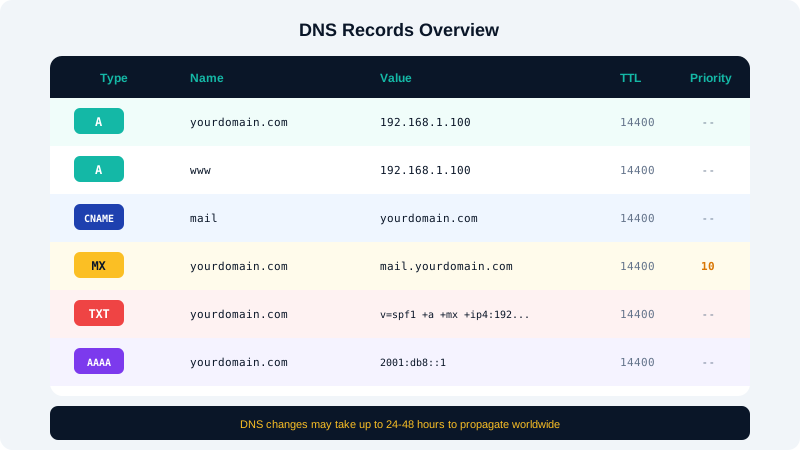
DNS (Domain Name System) records tell the internet where to direct traffic for your domain. Here is a breakdown of the most common record types.
A Record
An A record maps a domain name to an IPv4 address. This is the most fundamental DNS record — it tells browsers which server to connect to when someone visits your domain.
Example: yourdomain.com → 192.0.2.1
AAAA Record
An AAAA record is the same as an A record but for IPv6 addresses. As IPv6 adoption grows, having an AAAA record ensures your site is reachable over the newer protocol.
Example: yourdomain.com → 2001:0db8::1
CNAME Record
A CNAME (Canonical Name) record creates an alias from one domain name to another. It is commonly used for subdomains.
Example: www.yourdomain.com → yourdomain.com
Note: You cannot set a CNAME on the root domain (@). Use an A record for that.
MX Record
MX (Mail Exchange) records specify which mail servers handle email for your domain. Each MX record has a priority value — lower numbers have higher priority.
Example:
- Priority 10:
mail.yourdomain.com - Priority 20:
backup-mail.yourdomain.com
TXT Record
TXT records store text data and are used for various verification and security purposes:
- SPF: Specifies which servers are authorized to send email for your domain.
- DKIM: Provides a cryptographic signature for email authentication.
- DMARC: Defines how receiving servers should handle emails that fail SPF or DKIM checks.
- Domain verification: Services like Google and Microsoft use TXT records to verify domain ownership.
SRV Record
SRV (Service) records specify the host and port for specific services like VoIP, XMPP, or other protocols.
CAA Record
CAA (Certificate Authority Authorization) records specify which certificate authorities are allowed to issue SSL certificates for your domain. This adds a layer of security against unauthorized certificate issuance.
Managing DNS Records
In cPanel, you can manage DNS records through the Zone Editor. Click Zone Editor under the Domains section to add, edit, or delete records for your domains.